Hawaiian Food: 15 Dishes Worth Traveling For
From pounded taro and underground-oven pork to the beloved plate lunch, here is what Hawaiian food really is, how it tastes, and how to order it with confidence.
What is Hawaiian food? Hawaiian food is the cuisine of the Hawaiian Islands. It blends ancient Polynesian staples such as taro, sweet potato, fish and slow-cooked pork with flavors brought by Chinese, Japanese, Portuguese, Filipino, Korean and American settlers. The result is one of the most distinctive food cultures in the United States.
A short history of Hawaiian food
Polynesian voyagers reached Hawaii more than a thousand years ago. They carried canoe plants such as taro (kalo), sweet potato (‘uala), breadfruit (‘ulu), banana, sugarcane and coconut. Those crops, plus fish and a few animals like pigs and chickens, formed the base of the traditional diet.
Everything changed in the 1800s. Sugar and pineapple plantations drew workers from China, Japan, Portugal, the Philippines and Korea. Each group brought recipes, and local cooks mixed them together. That is why a single Hawaiian meal might include rice, macaroni salad, teriyaki beef and slow-roasted pork.
Hawaii became the 50th US state in 1959. Today, food in the islands is best described as a “local food” tradition: indigenous roots with a multicultural top layer.
Traditional Hawaiian dishes
These dishes trace back to pre-contact Hawaii and still appear at luaus, family gatherings and Hawaiian restaurants.
1. Poi
Poi is the most iconic traditional Hawaiian food. Cooked taro root is pounded with water into a smooth, purple-gray paste. Fresh poi tastes mild and slightly sweet. After a day or two it ferments and turns tangy, like yogurt.
Tip: Many first-timers dislike poi on its own. Eat it with salty partners like lomi salmon or kalua pig, as locals do.
2. Kalua pig
Kalua means “to cook in an underground oven.” A whole pig is seasoned with sea salt, wrapped in banana or ti leaves and steamed in an imu for hours. The meat comes out smoky, tender and shreddable. Restaurants often use ovens and liquid smoke to get a similar flavor.
3. Lau lau
Lau lau is pork (sometimes fish or chicken) wrapped in taro leaves and then in ti leaves, then steamed for hours. The taro leaves soften into a silky, spinach-like layer. It is a staple of many “hawaiian food near me” searches for good reason: a proper lau lau is deeply comforting.
4. Lomi-lomi salmon
Salted salmon is massaged (“lomi”) with diced tomato, onion and sometimes chili pepper. Served cold, it works like a fresh salsa that cuts through rich meats and poi.
5. Poke
Poke (pronounced poh-keh) means “to slice or cut.” Traditionally, it was cubes of raw reef fish with sea salt, seaweed (limu) and roasted kukui nut (‘inamona). Modern versions often add soy sauce, sesame oil and green onion.
Common poke styles
- Shoyu ahi: yellowfin tuna, soy sauce, sesame oil, onion
- Spicy ahi: mayo and chili sauce mix
- Limu poke: seaweed-forward and closer to the traditional style
6. Haupia
This chilled coconut pudding is cut into firm squares. It is light, creamy and often served at luaus beside cake or pie.
7. Squid luau and other taro-leaf dishes
Luau leaves (young taro tops) are simmered with coconut milk and octopus or chicken until creamy. The flavor is earthy and rich.
A “luau” was originally the name of the taro leaf. The feast we call a luau today took the name later.
Modern local favorites
These dishes are not ancient, but they are everywhere in Hawaii and define everyday eating.
8. Plate lunch
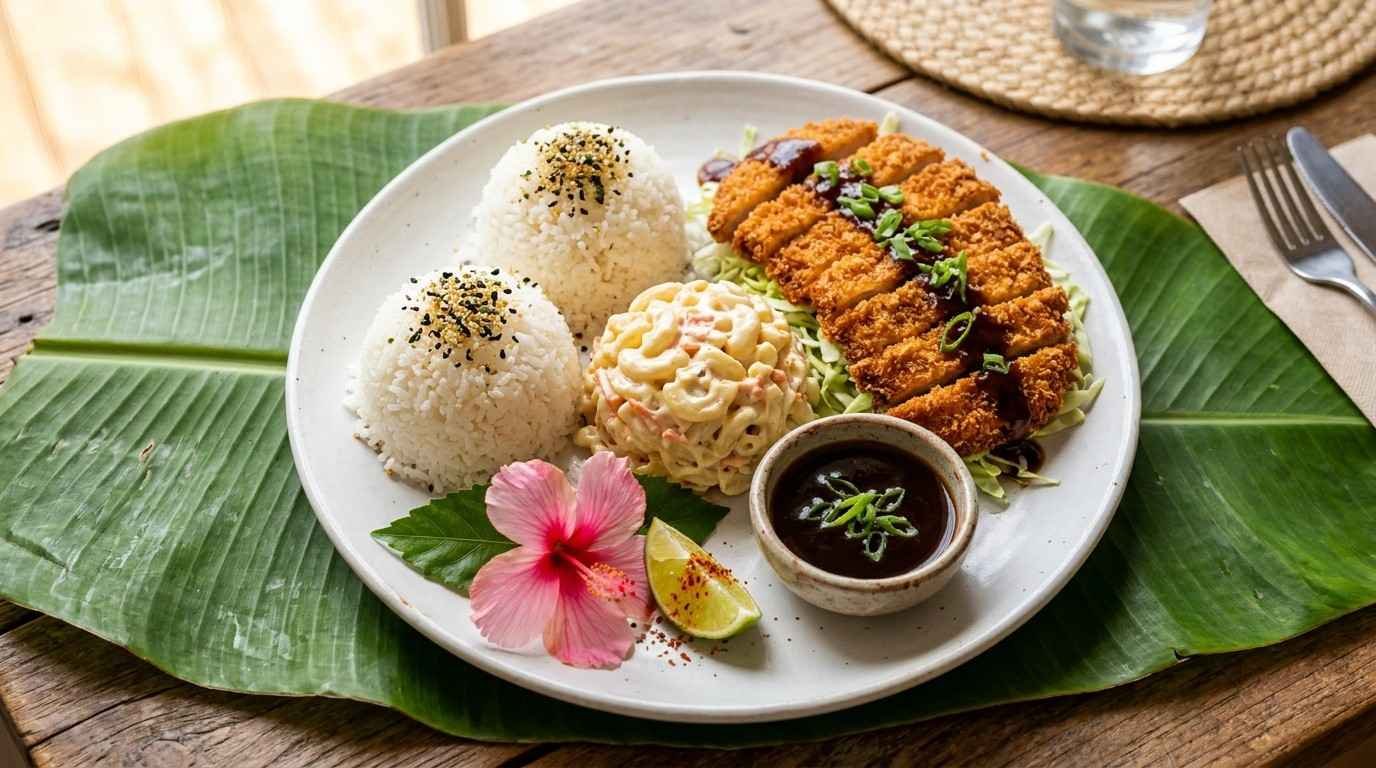
The plate lunch is the heart of local dining: two scoops of white rice, one scoop of macaroni salad and a hot main such as chicken katsu, teriyaki beef or kalua pork. It grew from lunch pails of plantation and dock workers. Expect big portions and low prices.
9. Loco moco
A hamburger patty over rice, covered in brown gravy and topped with a fried egg. It is rich, hearty and a famous breakfast-or-anytime comfort dish.
10. Spam musubi
A slice of grilled Spam sits on a block of rice, wrapped in nori like sushi. Spam became popular in Hawaii during World War II, and the islands are often cited as among the highest per-capita Spam consumers in the US. It is a classic gas-station and beach snack.
11. Chicken katsu and saimin
Crispy breaded chicken shows Japanese influence. Saimin, a noodle soup with dashi broth, comes from the same mix of Japanese, Chinese and Filipino noodle traditions.
12. Portuguese sausage and malasadas
Portuguese immigrants brought spiced sausage and malasadas, fluffy sugar-coated doughnuts without a hole. Try them hot.
Desserts and snacks
13. Shave ice
Shave ice is not a snow cone. The ice is shaved into a soft, fluffy texture that absorbs syrup evenly. Locals add azuki beans, ice cream or condensed milk at the bottom.
14. Manapua
This steamed or baked bun with sweet roasted pork filling descends from Chinese char siu bao.
15. Kulolo and butter mochi
Kulolo is a dense, chewy pudding of taro and coconut. Butter mochi is a chewy coconut-milk cake with crisp edges.
Quick comparison table
| Dish | Main ingredient | Taste | Origin |
|---|---|---|---|
| Poi | Taro | Mild, tangy when aged | Native Hawaiian |
| Kalua pig | Pork | Smoky, salty | Native Hawaiian |
| Lau lau | Pork or fish, taro leaf | Savory, silky | Native Hawaiian |
| Poke | Raw fish | Fresh, umami | Native, modernized |
| Plate lunch | Rice, mac salad, protein | Hearty, savory | Plantation era |
| Loco moco | Beef patty, egg, gravy | Rich, salty | 1940s Hilo |
| Shave ice | Ice, syrup | Sweet, cold | Japanese influence |
How to order Hawaiian food like a local
- Start with a combo plate. Kalua pig, lau lau, lomi salmon and poi give a full tasting.
- Try food trucks. A hawaiian food truck is often cheaper and fresher than a tourist restaurant.
- Check for local favorites. Long lines of residents beat polished menus.
- Go early for lau lau and poke. Popular spots sell out by mid-afternoon.
- Read recent reviews. Look for mentions of freshness and portion size.
Looking for Hawaiian food near you?
Search “hawaiian food near me” in a map app, then filter by recent reviews and open hours. Outside Hawaii, big cities such as Las Vegas, Portland and San Diego all have Hawaiian restaurants, since each has large Hawaiian communities. Look for kalua pork, real mac salad and menus listing poi or lau lau, which signal authenticity.
Halal, kosher and dietary notes
Hawaiian cuisine uses a lot of pork, so diners following halal rules should read menus closely. Kalua pig, lau lau, Spam musubi, manapua and Portuguese sausage usually contain pork. Some sauces also include alcohol such as mirin or sake.
Choose fish-based poke (confirm the sauce), vegetable plates, rice and plain grilled fish. Chicken must come from a halal source, so ask the restaurant directly.
Curious about the rules? Read is halal food kosher, is kosher food halal and is all kosher food halal. Our guide on what is kosher food explains the other dietary law, and is vegetarian food halal helps with plant-based plates. For more options, browse Halal Food Near Me.
On general health, traditional foods like poi, fish, sweet potato and seaweed are nutritious. Modern plate lunches can be high in fat and sodium, so ask for a half portion of rice or swap in a green salad.
Cooking Hawaiian food at home
- Easy kalua pork: rub a pork shoulder with Hawaiian sea salt, add liquid smoke and slow-cook for 8 hours, then shred.
- Quick poke: cube sushi-grade tuna and mix with soy sauce, sesame oil, onion and sesame seeds. Eat the same day.
- Mac salad: overcook the macaroni slightly, then mix with mayo, grated carrot and a splash of vinegar.
Tip: Buy raw fish only from a trusted seller and keep it cold.
Hawaiian food FAQ
What is traditional Hawaiian food?
It centers on taro (poi), sweet potato, breadfruit, fish, kalua pig, coconut, seaweed and sea salt.
What is the most popular Hawaiian food?
The plate lunch is the everyday favorite, while poke, kalua pig and shave ice are the best-known tourist picks.
What is poi made of?
Poi is cooked taro root pounded with water into a smooth paste.
Is Hawaiian food healthy?
Traditional foods are nutritious. Modern plate lunches can be heavy, so balance portions.
Is Hawaiian food halal?
Not always. Pork and Spam are common, but fish, vegetable and carefully sourced chicken dishes can work if no pork products or alcohol are used.
Conclusion
Hawaiian food tells the story of the islands: Polynesian roots, plantation-era migration and today’s laid-back local table. Start with poi, kalua pig and lau lau for tradition, then enjoy plate lunch, poke and shave ice for the modern side. Check ingredients if you follow halal or other dietary rules, and look for recent reviews before you go.
Ready to explore more? Browse Halal Food Near Me for dietary guides and restaurant ideas.