Halal Food Open Near Me: How to Find It Right Now
A practical, step-by-step guide to locating halal restaurants that are actually open near you — plus how to confirm they’re genuinely halal before you order.
It’s 9:40 p.m., you’re hungry, and you’re typing “halal food open near me” into your phone for the third time this week. You’re not alone — this is one of the most common late-night, on-the-go food searches for Muslim diners across the US, and the honest answer is that finding a real answer takes more than one Google search. This guide breaks down exactly how to do it, fast.
What’s in this guide
- What “halal food open near me” actually means
- How to find halal food open near you right now
- How to verify a restaurant is genuinely halal
- Types of halal food you’re likely to find nearby
- Halal food trends worth knowing in 2026
- Real example: searching a growing US city
- Delivery vs. dine-in when you’re short on time
- Common mistakes to avoid
- FAQs
What Does “Halal Food Open Near Me” Actually Mean?
On the surface, this search looks simple: find a restaurant, near me, that serves halal food, right now. But there are actually three separate conditions bundled into that one phrase, and most map apps only solve one of them well.
- Halal — the food is prepared according to Islamic dietary law, meaning no pork or pork by-products, no alcohol used in preparation, and meat from animals slaughtered following zabiha guidelines.
- Near me — the place is within a realistic driving, walking, or delivery radius of your current location.
- Open now — the kitchen is actually taking orders at this exact moment, not just listed with generic “hours” that haven’t been updated in months.
Understanding Halal Certification
Halal certification isn’t one single global stamp — it varies by country, certifying body, and even by individual restaurant. In the US, some restaurants carry a formal certificate from an accredited Islamic organization, while many smaller, family-run spots are “halal by ownership,” meaning the owners are Muslim and the entire menu avoids pork and alcohol, without a formal third-party certificate. Both are common, and both matter for different reasons discussed later in this guide.
Why “Open Now” Matters More Than People Realize
Halal restaurants are still a smaller share of the overall restaurant market in most US cities, which means options thin out fast after 9 p.m. A restaurant’s listed hours on Google or Yelp can lag behind reality — holiday closures, staff shortages, or a kitchen that stops taking orders 30 minutes before the posted closing time are all common. That’s why cross-checking two sources before you drive somewhere saves real frustration.
How to Find Halal Food Open Near You Right Now
Here’s the fastest, most reliable order of operations, based on how each platform actually sources its data.
1. Start With Google Maps, Filtered Correctly
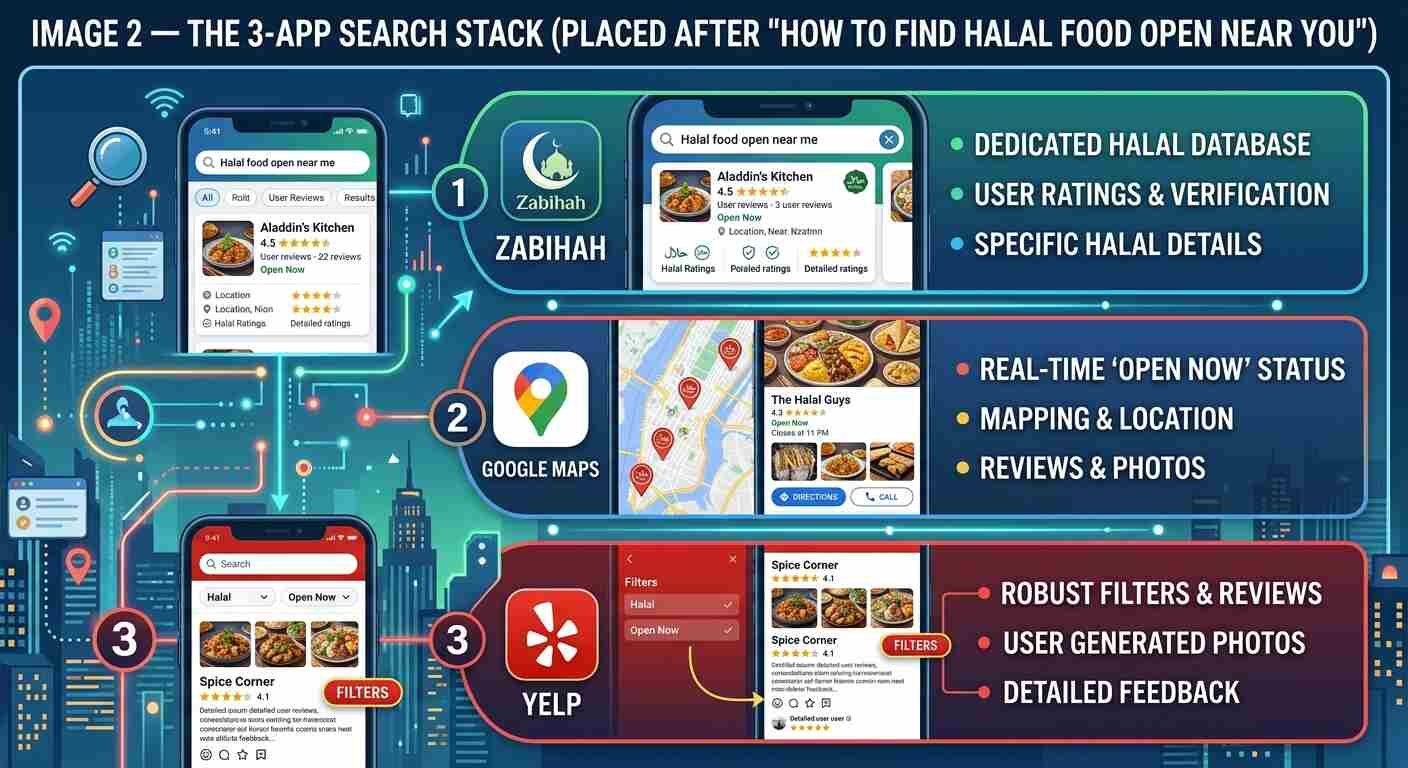
Search “halal food near me” directly in Google Maps rather than the general search bar — it defaults to distance-sorted results and shows a live “Open now” badge pulled from the business’s Google Business Profile. Tap into a listing and check the “Popular times” graph; if it shows a steep drop-off, the kitchen may be winding down even if it’s technically still open.
2. Cross-Check on Delivery Apps
DoorDash and Uber Eats both let you filter by cuisine, and both only display restaurants that are actively accepting orders — which makes them one of the most reliable real-time signals for “is this place actually open.” Search “halal” as a cuisine filter in your city on either app; if a restaurant appears there and is toggled on, it’s taking orders this minute.
3. Use a Dedicated Halal Directory
General map apps don’t verify halal status — they just repeat whatever the business listed. Halal-specific directories like Zabihah exist precisely to solve this gap: they log whether a restaurant is fully halal, partially halal (meaning only some menu items are halal, and alcohol may be served), or halal by ownership, along with community reviews on accuracy. This is the single best resource for confirming halal status specifically, even if you still need Google or a delivery app to confirm current hours.
4. Check Local Community Groups
Facebook groups and city-specific subreddits (for example, a local city’s community subreddit) are surprisingly good for catching brand-new openings before they show up anywhere else. New halal spots often post “we’re open” announcements in these groups weeks before their Google listing is even claimed.
Source: The Business Research Company, Halal Food Market Report 2026
How to Verify a Restaurant Is Truly Halal
Not every restaurant that appears in a “halal” search filter is fully halal, and the difference matters to many diners. Here’s how experienced halal diners actually check.
Look for Certification Signage
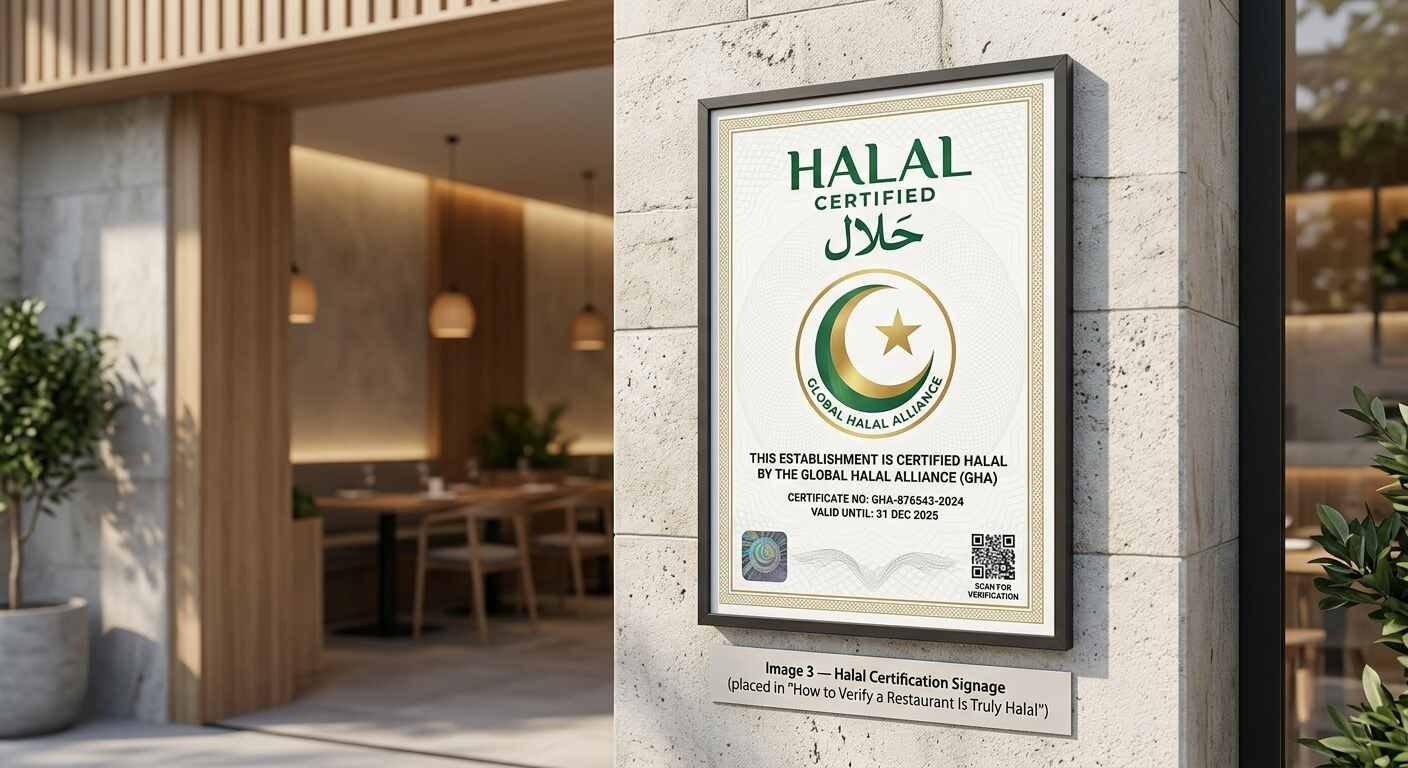
A visible certificate from an accredited Islamic organization, usually framed near the register or listed on the menu, is the clearest signal. If you don’t see one, that doesn’t automatically mean the food isn’t halal — many honest, halal-only restaurants simply haven’t pursued formal certification — but it does mean you should ask.
Ask Direct, Specific Questions
Staff can usually answer these on the spot:
- “Is your meat zabiha halal, and where does it come from?”
- “Is the whole menu halal, or only certain dishes?”
- “Do you serve alcohol, or is it used in any sauces or marinades?”
Check Community Reviews Before You Go
On halal-specific directories, look at whether the restaurant is tagged “fully halal” versus “partially halal,” and read the most recent reviews — halal status can change if a restaurant switches meat suppliers or ownership. A five-year-old review confirming halal meat isn’t as reliable as one from the past few months.
Types of Halal Food You’re Likely to Find Nearby
Halal food is not one cuisine — it’s a dietary standard that applies across dozens of cuisines. Here’s what typically shows up in a local search, and what to expect from each.
| Cuisine Type | Common Dishes | Good For |
|---|---|---|
| Middle Eastern | Shawarma, kebabs, falafel, hummus platters | Quick lunch, casual dine-in |
| South Asian (Indian/Pakistani) | Biryani, karahi, nihari, tandoori | Family dinners, larger groups |
| American Halal | Halal burgers, halal fried chicken, halal food trucks | Fast, familiar comfort food |
| Mediterranean | Gyros, grilled meats, mezze plates | Lighter meals, meal prep |
| East/Southeast Asian Halal | Halal Chinese, halal Thai, halal sushi | Variety-seekers, delivery orders |
| Halal Grocery/Butcher | Raw zabiha meat, spices, frozen items | Cooking at home |
Halal Food Trends Worth Knowing in 2026
A few shifts are changing how halal food shows up in local search results:
- Faster market growth than the overall restaurant industry. Industry research projects the global halal food market growing from roughly $1.97 trillion in 2025 to $2.24 trillion in 2026, driven partly by expanding certification bodies and growing demand from both Muslim and non-Muslim consumers who associate halal with stricter hygiene and quality checks.
- More independent halal spots, not just chains. Small, owner-run halal restaurants and food trucks continue to open in mid-sized US cities, often announced first on local Facebook groups before they’re findable on Google.
- Delivery apps are becoming the fastest way to confirm “open now.” Because DoorDash and Uber Eats only surface restaurants actively accepting orders, they’ve quietly become one of the most accurate real-time “is it open” tools — more reliable in the moment than a business’s static Google hours.
Real Example: Searching for Halal Food in a Growing US City
To see how this plays out in practice, take a mid-sized city like Wichita, Kansas — a market that isn’t traditionally known as a halal food hub but has been steadily growing its options. A dedicated halal directory lists a handful of verified halal restaurants and halal grocery stores across the city, spanning Indian, Pakistani, Mediterranean, and American cuisines, plus a couple of halal butchers supplying fresh zabiha meat.
Local Facebook groups and community subreddits in Wichita have also been where residents first learn about new halal spots — posts about a new halal food stand or a “coming soon” sign at a storefront often circulate locally well before the business shows up in a standard Google search. This pattern — smaller cities relying on community word-of-mouth to fill the gap left by mainstream search — repeats in mid-sized cities across the country, which is exactly why checking more than one source matters, no matter where you live.
Halal Food Delivery vs. Dine-In: Which Is Better When You’re Short on Time
| Factor | Delivery Apps | Dine-In |
|---|---|---|
| Speed of confirming “open now” | Very high — only live restaurants appear | Depends on Google hours accuracy |
| Ability to verify halal status | Limited — relies on menu description | High — you can ask staff directly |
| Best for | Late nights, bad weather, no time to drive | First-time visits, checking certification |
| Typical cost | Menu price + delivery/service fees | Menu price only |
Common Mistakes to Avoid When Searching for Halal Food Near You
- Trusting a single app’s hours. Always check a second source if the restaurant is worth the drive.
- Assuming “Middle Eastern” or “Indian” automatically means halal. Cuisine type and halal status are not the same thing — always confirm.
- Skipping the “partially halal” label. Some restaurants serve halal meat but also pour alcohol, which matters to many diners.
- Ignoring recent reviews. Halal status can change with new ownership or a new meat supplier.
- Not calling ahead for late-night orders. Kitchens frequently stop taking orders before their posted closing time.
Frequently Asked Questions
How do I know if a restaurant near me is actually halal?
Look for a visible halal certification, check a dedicated halal directory for its “fully halal” or “partially halal” status, and when in doubt, ask staff directly whether the meat is zabiha-certified and whether alcohol is served anywhere on the menu.
What’s the difference between halal and zabiha?
Halal is the broader Islamic dietary standard covering all permissible food and drink. Zabiha specifically refers to the Islamic method of slaughtering animals, which is the step that makes meat halal in the first place.
Are DoorDash and Uber Eats reliable for finding halal food that’s actually open?
They’re reliable for confirming a restaurant is currently accepting orders, since closed restaurants don’t appear as active. They’re less reliable for confirming halal status itself, since that information comes from the restaurant’s own menu description rather than independent verification.
Why do some halal restaurants also serve alcohol?
Some restaurants serve halal meat prepared according to Islamic guidelines while still holding a liquor license for other menu items or bar service. Halal directories typically label these as “partially halal” so diners can make an informed choice.
What should I do if there’s no halal restaurant open near me right now?
Check a halal grocery store or butcher — many stay open later than restaurants and sell ready-to-eat items, or check delivery apps for a wider radius than you’d normally drive, since delivery range often extends further than a comfortable walk or short drive.
Conclusion
Finding halal food that’s genuinely open near you comes down to layering three tools instead of relying on one: a map app for distance and live hours, a delivery app for real-time “accepting orders” confirmation, and a dedicated halal directory to actually verify halal status. Add local community groups into the mix for newer spots, and you’ll consistently find better, more accurate results than a single Google search provides. The halal food market itself is only growing — projected to reach $2.24 trillion globally in 2026 — which means more options are coming to more cities every year. The next time hunger hits at an inconvenient hour, this three-step stack will get you to a real meal faster than guessing ever will.